Reading one research paper well is slow. Reading a whole field is slower. Paper Dive does both with me.
In reading mode it walks me from plain English up to expert-level understanding through conversation, not a summary dump, and it can stress-test a paper's claims. In citation-graph mode it starts from a few seed papers and builds a local knowledge base of everything around them, ranked by how relevant each paper really is.
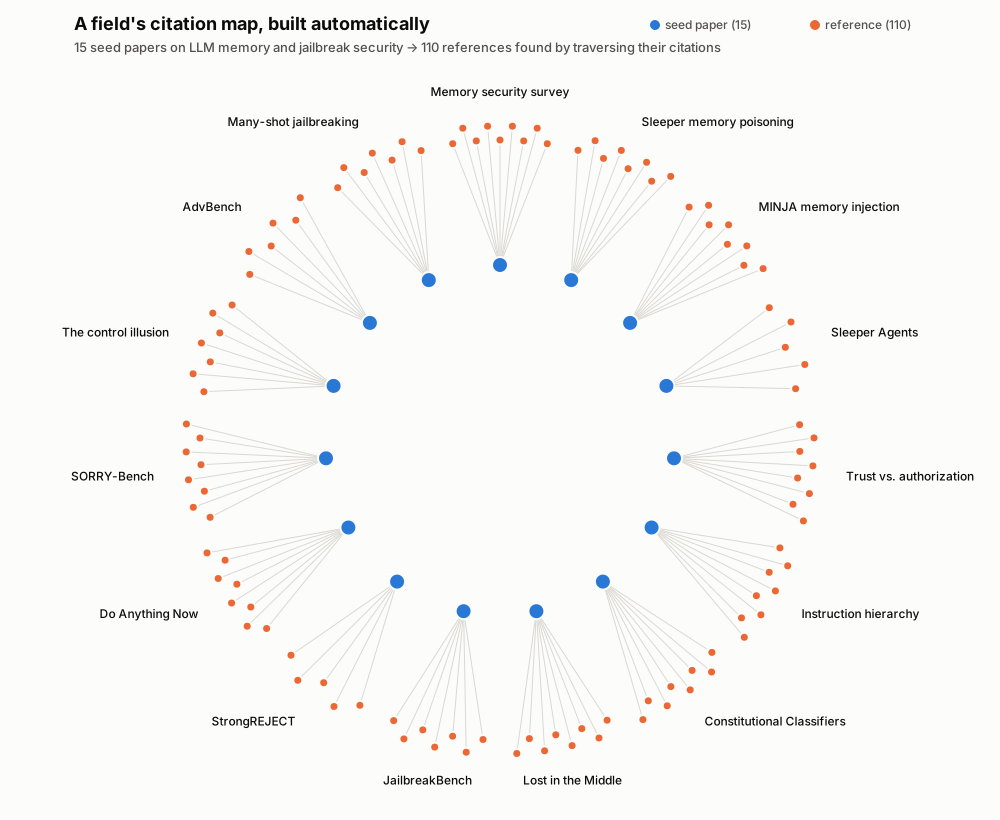
A field's citation map, built automatically
For a research paper I was writing, I gave it 15 seed papers on LLM memory and jailbreak security. It traversed their citations and pulled in 110 references, stored and de-duplicated on my machine.
It also caught two suspicious citations: papers from unrelated fields that only looked related to the embedding model. Now it flags anything from a different field for a human to check before it gets cited.
Set up once
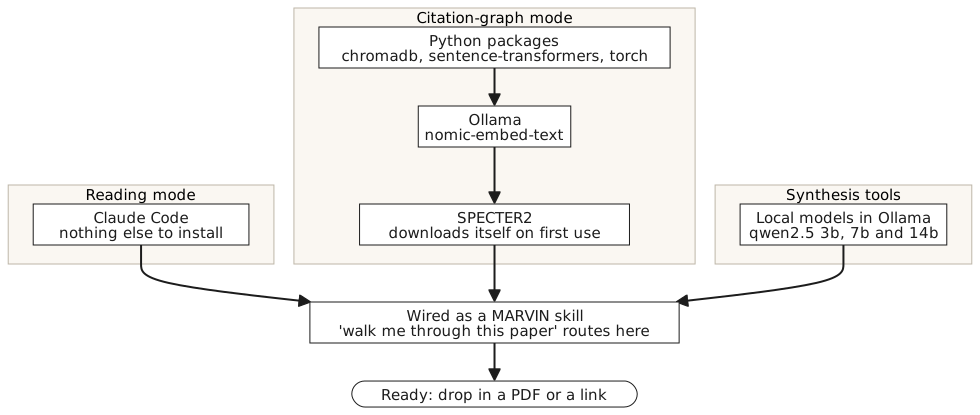
Reading mode needs nothing but Claude Code. Citation-graph mode adds a few Python packages and Ollama for one of its two embedding models; the other, SPECTER2, downloads itself the first time it runs. The synthesis tools use three small local models, so none of this costs anything per run. Then it's a MARVIN skill: I say "walk me through this paper" and drop in a PDF or a link.
Two modes, start to finish
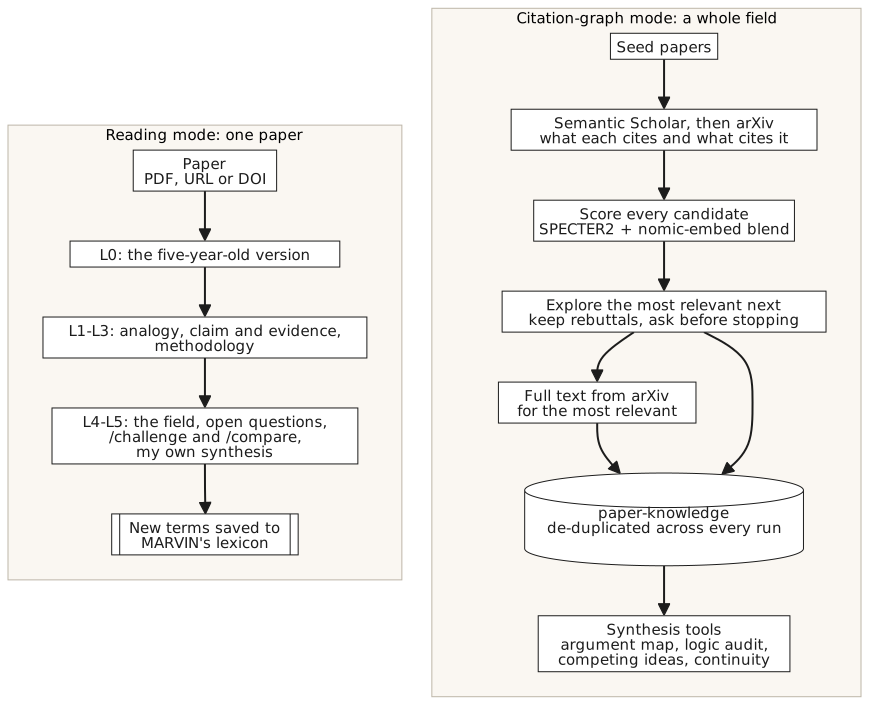
Reading mode climbs a ladder. It starts with the version you'd tell a five-year-old, then works up through an analogy from a field I already know, the actual claim and its evidence, the methods, the paper's place in its field, and finally open questions and my own synthesis. Along the way I can make it argue against the paper or compare it with another one. Every new term I learn is saved to MARVIN's lexicon, so the next paper skips what I already know.
Citation-graph mode maps a field. Plain breadth-first crawling drowns you in tangents, so Paper Dive scores every candidate with a blend of two embedding models, SPECTER2 (trained on citations) and nomic-embed, and always explores the most relevant paper next. A guardrail keeps papers that argue against the seed, and when the budget runs out it asks instead of stopping silently. For the most relevant papers it fetches the full text from arXiv. Everything lands in one local knowledge base, de-duplicated across every run.
Beyond reading
Four synthesis tools run on top of the knowledge base, all on local models through Ollama, so they cost nothing to run: an argument mapper (which papers each finding builds on), a logic auditor (does the paper's own argument hold up), a competing-ideas finder (who supports and who refutes a claim) and a continuity checker (do later papers really build on what they cite). The logic auditor's models were checked against 15 real abstracts; the competing-ideas finder and continuity checker are new, so I treat their output as a lead, not a verdict. 175 tests cover it all.
How MARVIN built it and keeps it running
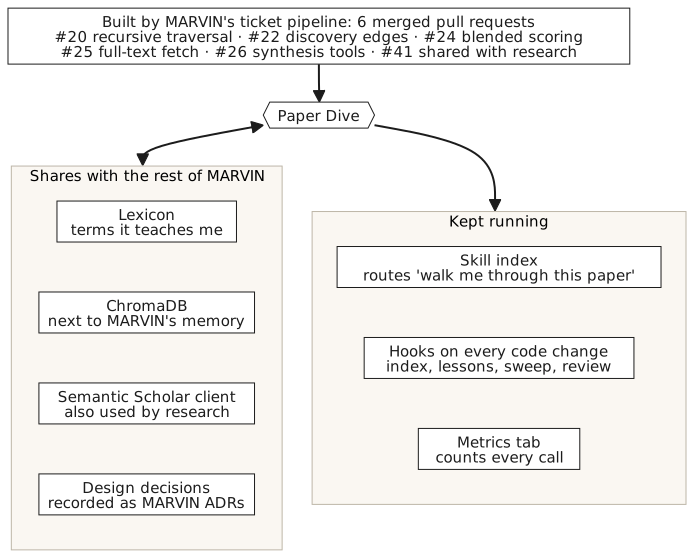
I designed Paper Dive, and MARVIN, the AI development system I built around Claude Code, built a lot of it. Its ticket pipeline implemented six features, from the recursive traversal to the synthesis tools, each one tested and merged as a pull request I approved.
It also shares parts with the rest of MARVIN: the lexicon it teaches me, the database next to MARVIN's memory, a Semantic Scholar client the research skill uses too, and design decisions recorded alongside MARVIN's own. Every code change runs the same hooks as any MARVIN skill, and the Metrics tab counts every call.